The army's most common vehicle is the High Mobility Multipurpose Wheeled Vehicle (HMMWV), commonly called the HUMVEE. It has largely supplanted the roles previously performed by the original jeep, and others such as the Vietnam War-era M151 jeep, the M561 "Gama Goat", their M718A1 and M792 ambulance versions, the Commercial Utility Cargo Vehicle (CUCV), and other light trucks. Primarily used by the United States military, it is also used by numerous other countries and organizations and even in civilian adaptations.

The M1A2 ABRAMS is the army's main battle tank. Highly mobile, designed for modern armored ground warfare, the M1 is well armed and heavily armored. Notable features include the use of a powerful multifuel turbine engine, the adoption of sophisticated composite armor, and separate ammunition storage in a blow-out compartment for crew safety.
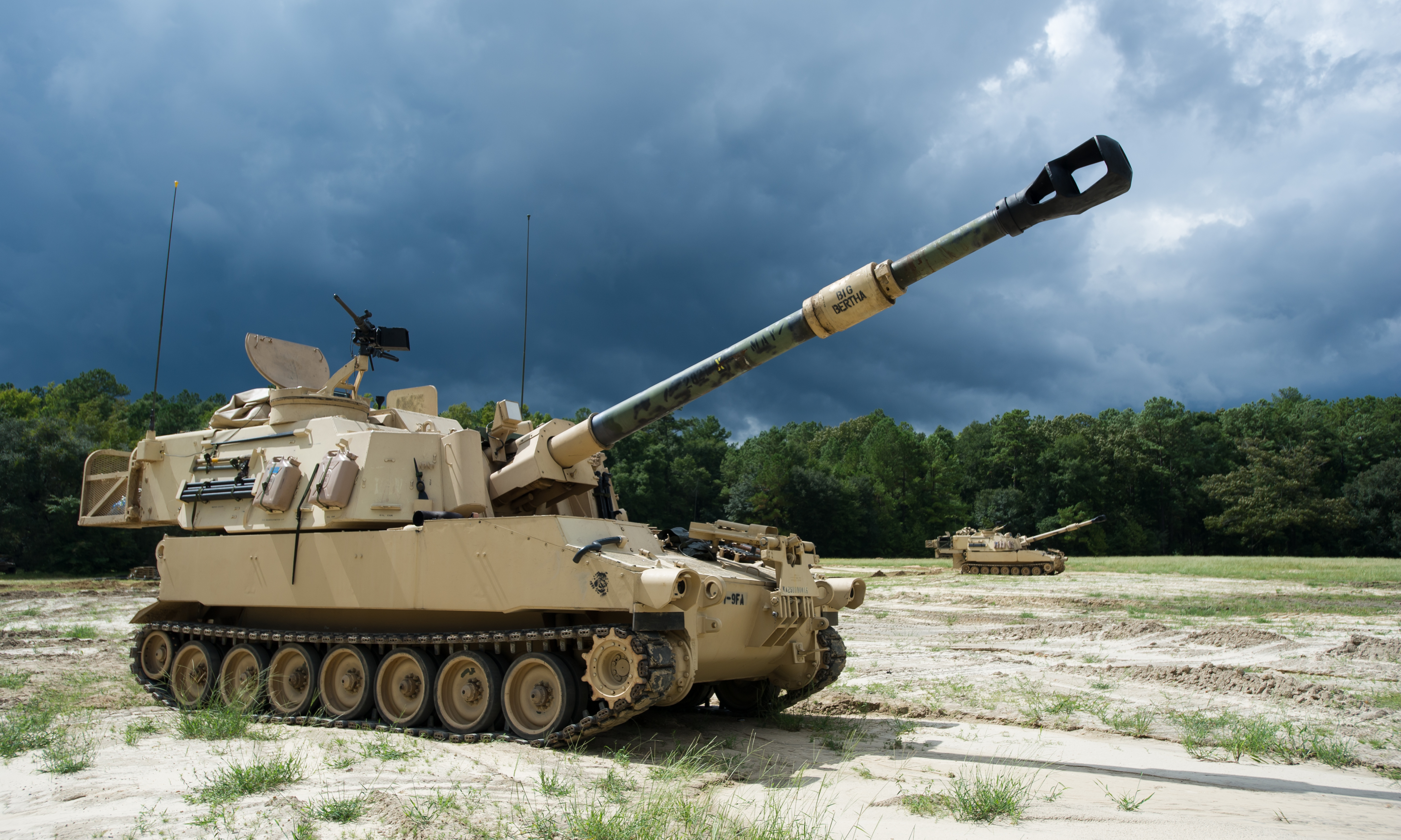
One of the U.S. Army's principal artillery weapons is the M109A6 PALADIN self-propelled howitzer. It has been upgraded a number of times, most recently to the M109A7. The M109 family is the most common western indirect-fire support weapon of maneuver brigades of armored and mechanized infantry divisions. The M109 is fitted with night-vision equipment, but does not have nuclear, biological and chemical (NBC) warfare protection. The vehicle can be fitted with an amphibious kit consisting of nine air bags, four on each side of the hull and one at the front.
The U.S. Air Force has over 5,638 aircraft in service as of September 2012. The various aircraft of the Air Force include:
Approved for production in 1990, the M1A2 represents the U.S. Army’s technological
improvement of the basic M1A1 design and the most modern battle tank in the world.
Internally, however, the M1A2 has been radically redesigned to take advantage of newer
technology. Most notable of these improvements is the addition of the Inter-Vehicle Information
System (IVIS.)
In addition enemy positions can be identified, plotted and disseminated, while reports
and artillery requests can be automatically formatted, transmitted, and processed.
Lastly, map graphic control measures and operational orders can be rapidly distributed
via the IVIS system. Power distribution throughout the tank has been improved, relying on
multiple bus paths so that in the event one conduit is damaged, power may still be delivered
to a component via an alternate path. The driver's instrument display has been upgraded to a
more detailed digital display and the Gunner's Primary Sight has been stabilized in two axes
for increased accuracy.
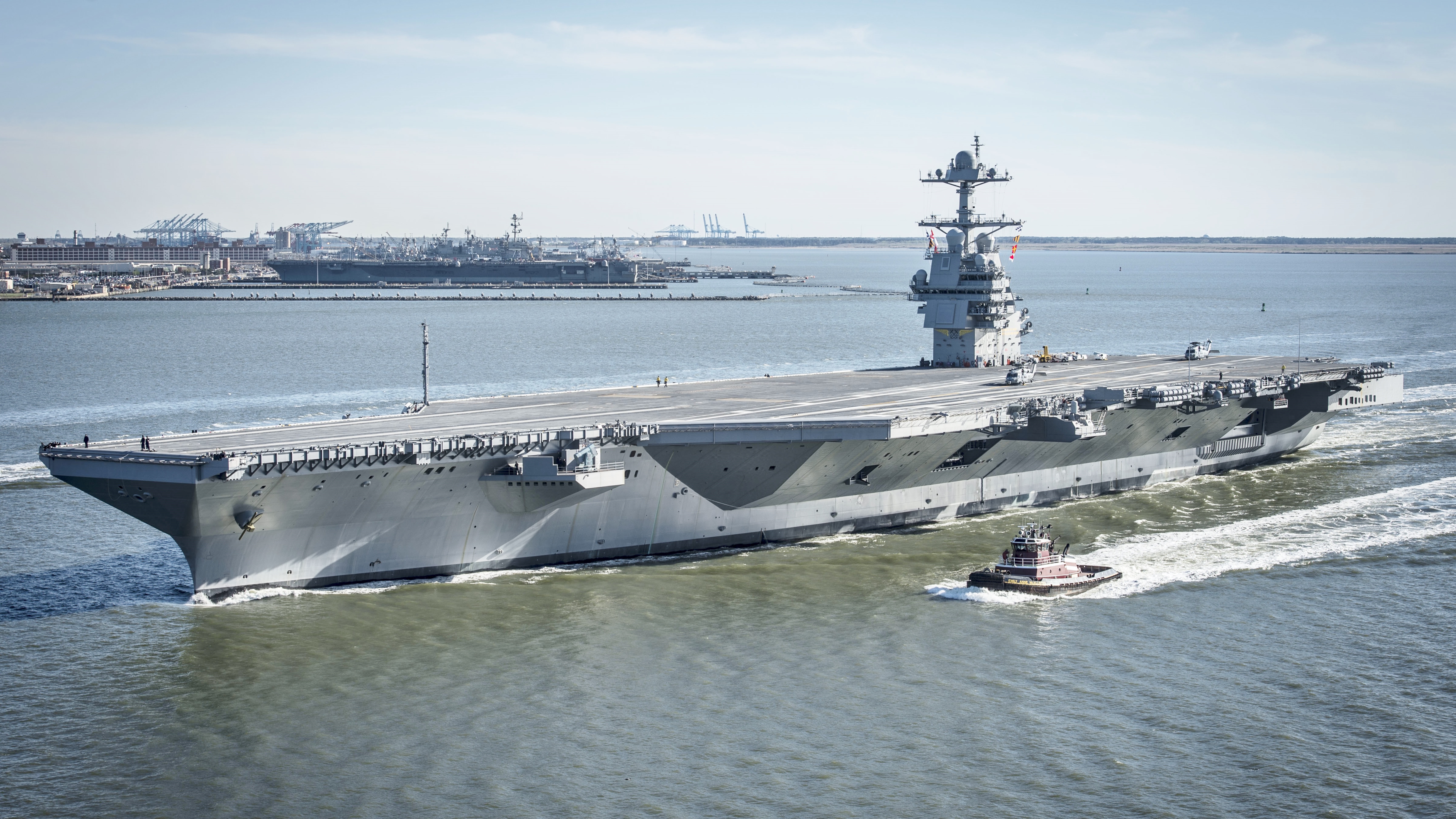
The Gerald R. Ford (CVN 78) was ordered from Newport News Shipbuilding on Sept.
10, 2008, and is scheduled to be delivered in 2016. Gerald R. Ford class aircraft carriers
and carrier strike groups will provide the core capabilities of forward presence, deterrence,
sea control, power projection, maritime security and humanitarian assistance.
Each ship in the new class will save more than $4 billion in total ownership costs
during its 50-year service life, compared to the Nimitz-class. The CVN 78 is designed to
operate effectively with nearly 700 fewer crew members than a CVN 68-class ship.
The new A1B reactor, Electromagnetic Aircraft Launch System, Advanced Arresting Gear
and Dual Band Radar all offer enhanced capability with reduced manning. The ship’s configuration
and electrical generating plant are designed to accommodate new systems, including direct energy
weapons, during its 50- year service life.
Designed during the Cold War as the world’s first low-observable or “stealth”
strategic bomber. The bomber represents a major milestone in the U.S. bomber modernization
program and brings massive firepower to bear anywhere on the globe through previously
impenetrable defenses.
The B-2 provides the penetrating flexibility and effectiveness inherent in manned
bombers. Its low-observable characteristics give it the unique ability to penetrate an
enemy's most sophisticated defenses and threaten its most valued, and heavily defended,
targets. Its capability to penetrate air defenses and threaten effective retaliation provides
a strong, effective deterrent and combat force well into the 21st century.
Its low-observability provides it greater freedom of action at high altitudes,
thus increasing its range and a better field of view for the aircraft's sensors.
Its unrefueled range is approximately 6,000 nautical miles (9,600 kilometers).
The E-4B is a converted 747-200 operated by the U.S. Air Force, and one of these
aircraft is aloft and ready to take charge of a nuclear crisis at all times.
In case of attack, the President, Vice President, or the Joint Chiefs of Staff would
meet up with the E-4B at a secret location and assume control of remaining American nuclear
forces. The E-4B would then fly a classified route over the United States, skirting
obvious nuclear targets, theoretically staying in the air for days at a time with the
help of Air Force midair refueling tankers.
The E-4B has advanced secure communications systems that would allow it to remain in
contact with America's nuclear forces in wartime. It is also protected against the effects
of electromagnetic pulse, a surge of electromagnetic radiation released by a nuclear explosion
that can knock out electrical and computer systems. The airplanes are also used by the
Secretary of Defense when he travels overseas, to provide a secure communications platform
and a means to whisk him or her to safety in a crisis.